
OTC11% OFF

₹58₹65
View DetailsLoading...
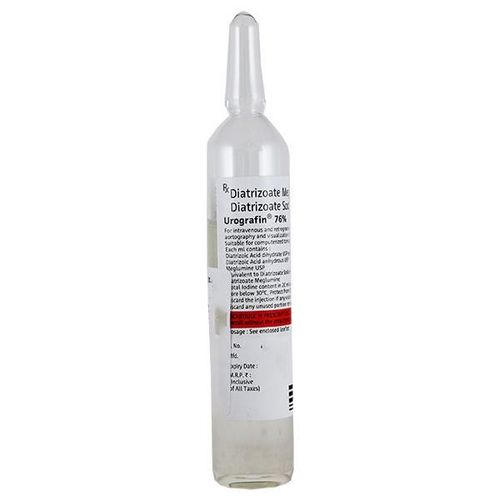
by Bayer Zydus Pharma Pvt Ltd· 20ML
SKU: 401243
You save ₹43 on this order
Inclusive of all taxes
UROGRAFIN 76% INJECTION contains Diatrizoate Meglumine and Diatrizoate Sodium
which belongs to group of medicines called Radiology contrast agents/X-ray dyes.
It is used as contrast medium in various radiographic examinations such as
excretion urography, paediatric angiocardiography, aortography, peripheral
arteriography, selective visceral arteriography, selective renal arteriography,
selective coronary arteriography, contrast enhancement during computed
tomographic brain imaging and during intravenous digital subtraction
angiography. UROGRAFIN 76% INJECTION is also used to enhance the contrast during
body’s computed tomography.
UROGRAFIN 76% INJECTION is not recommended for use in patients having severe
liver disturbances, severe kidney dysfunction, heart failure, an overactive
thyroid gland, acute inflammation of the pancreas, or heart failure.
UROGRAFIN 76% INJECTION should be used with caution in patients with severe
liver disturbances, severe kidney dysfunction, pulmonary emphysema, and
bronchial asthma. UROGRAFIN 76% INJECTION should also be used with caution in
pregnant females, breastfeeding mothers, the elderly, children, and adolescents
(under 16 years of age).
The common side effects associated with the use of UROGRAFIN 76% INJECTION are
nausea, vomiting, erythema (redness of the skin), pain, warmth, mild swelling of
the face, lips, tongue, or throat, and conjunctivitis (inflammation of the
eyes). Consult your doctor immediately or visit the nearby hospital.
UROGRAFIN 76% INJECTION helps in radiographic examination where diatrizoate
meglumine and diatrizoate sodium are the iodine containing agents that readily
diffuse in the vascular (inside the blood vessels) as well as extra-vascular
(outside the blood vessels) spaces and absorb the X-rays. The relative
differences in the concentration of the contrast medium in the tissues help in
differentiating normal and abnormal tissues, thereby helping in monitoring as
well as diagnosing the disease.
UROGRAFIN 76% INJECTION will be given to you only by a doctor or a nurse into
the vein. Your doctor will decide the correct dose and duration for you
depending upon your age, body weight and disease condition.
Stop receiving UROGRAFIN 76% INJECTION and contact your doctor if you experience
any of the following side effects:
!### Dizziness Or Drowsiness
Lie down until the dizziness passes, and then get up slowly. Do not bend down
suddenly. Get a lot of rest. Walk slowly and carefully. Take plenty of fluids.
Avoid drinking coffee, alcohol, or smoking. Consult your doctor if the condition
persists for a long time or gets worse.
Take rest and drink plenty of water. Avoid receiving alcohol and skipping meals.
Do not strain your eyes by watching the screen for a long time. Consult your
doctor if the condition persists for a long time or gets worse.
!### Nausea And Vomiting
Try to take UROGRAFIN 76% INJECTION with or just after a meal or a snack. Stick
to simple meals. Avoid eating rich or spicy food. Consult your doctor if the
symptom gets worse.
!### Pregnancy
Monitoring requiredUROGRAFIN 76% INJECTION should be used cautiously in pregnant females only if it
is considered clearly necessary. Consult your doctor before receiving it.
!### Breastfeeding
ContraindicatedUROGRAFIN 76% INJECTION is not recommended for use by breastfeeding mothers
since it may pass into the milk. Consult your doctor before receiving it.
!### Driving and Using Machines
Use with CautionDo not drive or operate machines after receiving UROGRAFIN 76% INJECTION as may
you experience delayed reactions such as fever, rash, flu-like symptoms, joint
pain, and itchiness . Consult your doctor before receiving it.
!### Kidney
Use with CautionUROGRAFIN 76% INJECTION should be used with caution in patients with severe
kidney dysfunction. Consult your doctor before receiving it.
!### Liver
Use with CautionUROGRAFIN 76% INJECTION should be used with caution in the patients having
severe liver disturbances. Consult your doctor before receiving it.
!### Allergy
ContraindicatedUROGRAFIN 76% INJECTION is not recommended for use if you are allergic to
diatrizoate meglumine, diatrizoate sodium, any other ingredients of this
medicine, food, or had any reactions to dyes used during previous X-ray
procedures. Consult your doctor before receiving it.
!### Lungs
Use with CautionUROGRAFIN 76% INJECTION should be used with caution in patients having pulmonary
emphysema (serious lung disease that can cause difficulty in breathing) or
bronchial asthma. Consult your doctor before receiving it.
!### Heart Disease
Consult your doctorUROGRAFIN 76% INJECTION is not recommended for use in patients with heart
failure (inability of heart to pump sufficient blood in the body). It should be
used with caution in patients with other heart diseases. Consult your doctor
before receiving it.
!### Use In Pediatrics
Use with CautionUROGRAFIN 76% INJECTION should be used with caution in children and adolescents
(below 16 years). Consult your doctor before receiving UROGRAFIN 76% INJECTION.
!### Use In Geriatrics
Use with CautionUROGRAFIN 76% INJECTION should be used with caution in elderly patients (above
65 years). Consult your doctor before receiving UROGRAFIN 76% INJECTION.
UROGRAFIN 76% INJECTION is not recommended for use if you:
Before receiving UROGRAFIN 76% INJECTION, inform your doctor if you:
A. Drug-Drug Interactions:
Before receiving UROGRAFIN 76% INJECTION, inform your doctor, if you are taking
any of the following medicine:
B. Drug-Food Interactions:
Avoid taking flatulent food such as peas, beans, lentils, salads, fruit, bread,
and uncooked vegetables two days prior to the examination.
Overdosage:
UROGRAFIN 76% INJECTION will be given to you only by a doctor or nurse in a
hospital, and so it is unlikely that you will receive an overdose. Symptoms of
overdose are cyanosis (bluish discoloration of nails, lips, and skin due to lack
of oxygen in the blood), bradycardia (slow heartbeat), acidosis (acid build-up
in the blood stream), pulmonary haemorrhage (bleeding in the lungs), convulsions
(repeated and uncontrolled contraction and relaxation of muscle), coma, and
cardiac arrest. Consult your doctor immediately or visit the nearby hospital.
| Drug | : | Diatrizoate Meglumine, Diatrizoate Sodium |
| Pharmacological Category | : | Radiology contrast agents/X-ray dyes |
| Therapeutic Indication | : | Radiographic examinations |
| Dosage Forms | : | Injection |
Q: What is UROGRAFIN 76% INJECTION used for?
A: UROGRAFIN 76% INJECTION is used as a contrast medium in various radiographic
examinations, such as excretion urography, paediatric angiocardiography,
aortography, peripheral arteriography, selective visceral arteriography,
selective renal arteriography, selective coronary arteriography, contrast
enhancement during computed tomographic brain imaging, and intravenous digital
subtraction angiography. It is also used to enhance the contrast during the
body’s computed tomography. Consult your doctor before receiving UROGRAFIN 76%
INJECTION.
Q: What happens if you take more UROGRAFIN 76% INJECTION than your required
dose?
A: UROGRAFIN 76% INJECTION will be given to you only by a doctor or nurse in a
hospital, and so it is unlikely that you will receive an overdose. Symptoms of
overdose are cyanosis, bradycardia, acidosis, pulmonary haemorrhage,
convulsions, coma, and cardiac arrest. Consult your doctor immediately or visit
the nearby hospital.
Q: What side effects are seen with UROGRAFIN 76% INJECTION?
A: The common side effects associated with the use of UROGRAFIN 76% INJECTION
are nausea, vomiting, erythema (redness of the skin), pain, warmth, mild
swelling of the face, lips, tongue, or throat, and conjunctivitis (inflammation
of the eyes). Consult your doctor immediately or visit the nearby hospital.
Q: Who should avoid receiving UROGRAFIN 76% INJECTION?
A: UROGRAFIN 76% INJECTION is not recommended for use in patients with severe
liver disturbances, severe kidney dysfunction, heart failure, an overactive
thyroid gland, acute inflammation of the pancreas, or heart failure. It should
be used with caution in patients with severe liver disturbances, severe kidney
dysfunction, pulmonary emphysema, and bronchial asthma. It should also be used
with caution in pregnant females, breastfeeding mothers, the elderly, children,
and adolescents (under 16 years of age). Consult your doctor before receiving
UROGRAFIN 76% INJECTION.
Q: How does UROGRAFIN 76% INJECTION work?
A: UROGRAFIN 76% INJECTION helps in radiographic examination, where diatrizoate
meglumine and diatrizoate sodium are the iodine-containing agents that readily
diffuse in the vascular (inside the blood vessels) as well as extra-vascular
(outside the blood vessels) spaces and absorb the X-rays. The relative
differences in the concentration of the contrast medium in the tissues help in
differentiating normal from abnormal tissues, thereby helping in monitoring as
well as diagnosing the disease.
Q: Can I drive while receiving alcohol?
A: Do not drive or operate machines after receiving UROGRAFIN 76% INJECTION as
you may experience delayed reactions such as fever, rash, flu-like symptoms,
joint pain, and itchiness. Consult your doctor before receiving UROGRAFIN 76%
INJECTION.
Q: What is the method of receiving UROGRAFIN 76% INJECTION?
A: UROGRAFIN 76% INJECTION will be given to you only by a doctor or a nurse and
placed into the vein. Your doctor will determine the correct dose and duration
for you depending upon your age, body weight, and disease condition.
Q: What medications should I avoid while receiving UROGRAFIN 76% INJECTION?
A: Before receiving UROGRAFIN 76% INJECTION, inform your doctor if you are
taking medicines that are used to manage diabetes (metformin), high blood
pressure or heart conditions (metoprolol), or interleukins. Consult your doctor
before receiving UROGRAFIN 76% INJECTION.
Q: Can UROGRAFIN 76% INJECTION cause flu?
A: Yes. UROGRAFIN 76% INJECTION may cause flu-like symptoms such as fever,
chills, sore throat, and cough in some patients, which are generally temporary
and resolve with time. However, contact your doctor if this condition worsens.
Q: How long does it take for UROGRAFIN 76% INJECTION to leave the body?
A: The normal kidney eliminates the UROGRAFIN 76% INJECTION almost immediately.
However, in infants and small children, excretion occurs somewhat more promptly
than in adults, where, in patients with kidney dysfunction, excretion is delayed
for around 30 minutes or more after injection. In patients with severe kidney
function impairment, the excretion process may not get initiated.


