
Rx11% OFF

₹165₹185.67
View DetailsLoading...
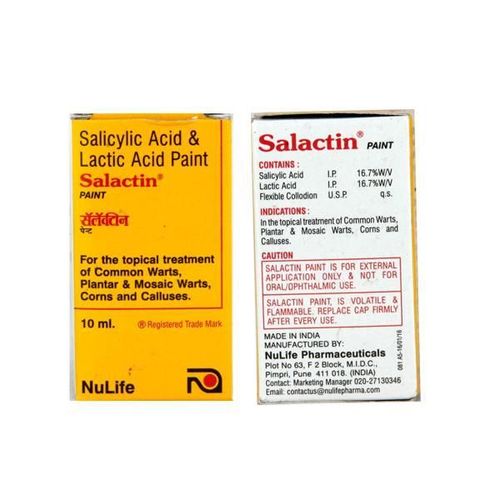
by Nulife Pharmaceuticals· 10ML
SKU: 55111
You save ₹57 on this order
Inclusive of all taxes
Salactin Paint is a collodion wart paint, used for the topical management of
common warts, plantar and mosaic warts, corns, and calluses (small rough growths
on the skin). It contains salicylic acid and lactic acid as active ingredients
that remove the corns and warts effectively and painlessly without scarring the
skin.
Salicylic acid has keratolytic properties that causes the breakdown of the
keratin layer. Lactic acid enhances the availability of salicylic acid and helps
in the breakdown of the skin's surface. On application, Salactin Paint dries and
leaves a flexible film over the site of application.
Always apply Salactin Paint as advised by your physician. It is for external use
only and not for oral or ophthalmic use. It can be safely used by children,
adults and elderly.
Consult your doctor if you notice any unusual side effects while using Salactin
Paint.
Q: Can I use Salactin Paint if I am diabetic?
A: Do not use it if you are diabetic or have poor blood circulation to your
hands or feet. Consult your doctor for further advice.
Q: What to do ifSalactin Paint gets into normal skin?
A: If you accidentally get Salactin Paint on your normal skin, immediately wipe
it off with a tissue and, if necessary, wash the area. If this occurs, apply a
small amount and be extra careful not to get any on areas other than the
affected area.
Q: What if I accidentally inhaleSalactin Paint?
A: You might feel dizzy if you inhale a lot of the Salactin Paint vapour. Get
lots of fresh air if this occurs and consult your doctor if dizziness persists.
Q: Can Salactin Paint cause irritation to my skin?
A: Unacceptable discomfort or persistent irritation can occur at the management
area, but this is very rare. If this happens, stop using Salactin Paint and tell
your doctor.
Q: Can we useSalactin Paint on face?
A: Salactin Paint is not recommended to use anywhere near or on the anal,
genital area, bottom, breasts, armpits, or your face (such as on birthmarks,
moles, warts with hairs growing out of them, or any other spot). Consult your
doctor for further queries.


