
Rx18% OFF

₹8101₹9880
View DetailsLoading...
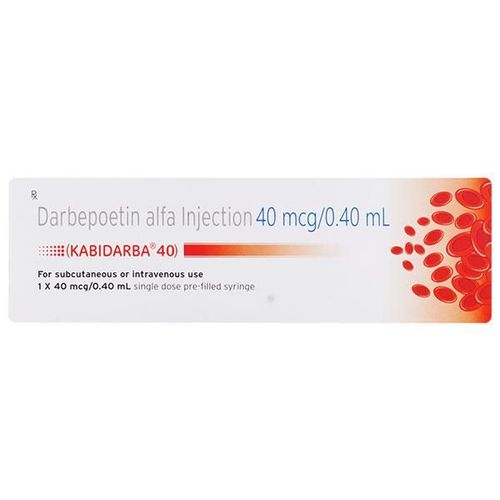
by Fresenius Kabi India Pvt Ltd· 0.40ML
SKU: 1067142
You save ₹342 on this order
Inclusive of all taxes
KABIDARBA 40 INJECTION contains Darbepoetin alfa which belongs to the group of
medicines called Erythropoiesis-stimulating agents. It is used to manage
symptomatic anemia associated with chronic renal failure (CRF) in adults and
children. In kidney failure, the kidney does not produce enough erythropoietin
(a natural hormone) which can often cause anemia.
Before KABIDARBA 40 INJECTION management, your doctor may want you to take blood
tests to measure how your anaemia is responding and may adjust your dose to
maintain long-term control of your condition. Your blood pressure will also be
checked regularly, especially at the beginning of your management.
KABIDARBA 40 INJECTION is not recommended for use in patients having high blood
pressure which is not being controlled. Before receiving KABIDARBA 40 INJECTION,
inform your doctor if you have or ever had high blood pressure which is being
controlled with medicines, sickle cell anemia, fits, liver disease, lack of
response to medicines used to manage anemia, latex allergy or hepatitis C.
KABIDARBA 40 INJECTION should be used with caution in pregnant women. Patients
must not breastfeed while receiving KABIDARBA 40 INJECTION. No data is available
regarding KABIDARBA 40 INJECTION use in children (less than 1 month old) with
CKD receiving and not receiving dialysis. The safety and efficacy of KABIDARBA
40 INJECTION in children with cancer have not been established so, consult your
child’s doctor for advice.
The most common side effects of receiving KABIDARBA 40 INJECTION are high blood
pressure, allergic reactions, pain around the area injected and rash or redness
of the skin. Call your doctor if any of the symptoms worsen.
Manages symptomatic anemia
KABIDARBA 40 INJECTION increases red blood cell counts by stimulating the bone
marrow (soft tissue inside the bones where blood is made) to make more red blood
cells.
KABIDARBA 40 INJECTION will be given to you only by a doctor or a nurse either
under your skin (subcutaneous) or into a vein (intravenous). Your doctor will
decide on a proper dose and duration depending on your age, body weight and
disease condition. Do not stop receiving KABIDARBA 40 INJECTION unless your
doctor advises you to stop.
Stop receiving KABIDARBA 40 INJECTION and contact your doctor immediately if you
experience any of the following side effects:
Skin rash:
Avoid hot showers as they can further irritate your skin. Do not scratch the
affected area. Use protective clothing when going outdoors. Regularly moisturize
your skin. If the symptom persists, contact your doctor.
Drowsiness:
Try a few lifestyle changes to improve your energy levels when you feel drowsy
such as taking and maintaining a consistent sleep schedule. Exercise regularly
(such as a daily walk or running) and eat a nutritious diet with plenty of whole
grains, legumes, fruits and vegetables. If the symptom persists, contact your
doctor.
Headache:
Drink plenty of water and get adequate rest. Try to be relaxed and stress-free.
Call your doctor before taking any medicine for headaches. If the headache
persists, consult your doctor.
Nausea:
Take regular sips of a cold drink. Have ginger or peppermint tea. Stick to
simple meals. Avoid eating oily or spicy foods. If the symptom persists, contact
your doctor.
Vomiting:
Get adequate rest. Drink lots of fluids, especially water. Have small sips if
you feel sick. Eat when you feel like it – no need to eat or avoid any specific
foods. If the symptom persists, contact your doctor.
!### Pregnancy
KABIDARBA 40 INJECTION should be used with caution in pregnant women. If you are
pregnant, think you may be pregnant or are planning for a baby, consult your
doctor before receiving it.
!### Breastfeeding
KABIDARBA 40 INJECTION is not recommended for use in breastfeeding women because
it is not known if it is excreted in breast milk. Consult your doctor before
receiving it.
!### Driving and Using Machines
KABIDARBA 40 INJECTION should not affect the ability to drive or use machines.
!### Kidney
In patients with chronic kidney failure, your doctor will adjust the correct
dose and duration of KABIDARBA 40 INJECTION management depending on your age,
body weight and disease condition. Consult your doctor before receiving
KABIDARBA 40 INJECTION.
!### Liver
KABIDARBA 40 INJECTION should be used with caution in patients with liver
disease and hepatitis C. Consult your doctor before receiving KABIDARBA 40
INJECTION.
!### Allergy
Before receiving KABIDARBA 40 INJECTION inform your doctor if you are allergic
to Darbepoetin alfa or any of the other ingredients of this medicine or latex
(Ex. needle cap on the pre-filled syringe).
!### Heart Disease
KABIDARBA 40 INJECTION is not recommended for use in patients with high blood
pressure which is not being controlled with other medicines. KABIDARBA 40
INJECTION should be used with caution in patients with high blood pressure which
is being controlled. Consult your doctor before receiving KABIDARBA 40
INJECTION.
Before receiving KABIDARBA 40 INJECTION, inform your doctor if you have:
Use in pediatrics:
No data is available regarding KABIDARBA 40 INJECTION use in children (less than
1-month-old) with CKD receiving and not receiving dialysis. The safety and
efficacy of KABIDARBA 40 INJECTION in children with cancer have not been
established so, consult your child’s doctor for advice.
Use in geriatrics:
No differences in safety or efficacy have been observed between older and
younger patients. Consult your doctor before receiving KABIDARBA 40 INJECTION.
A. Drug-Drug interactions:
Before receiving KABIDARBA 40 INJECTION, inform your doctor if you are taking
any of the following medicines:
Overdosage:
KABIDARBA 40 INJECTION will be administered to you only by a doctor or a nurse
in a hospital, so it is unlikely to receive an overdose. However, consult your
doctor or nurse if you experience any unusual symptoms like high blood pressure.
| Drug | : | Darbepoetin alfa |
| Pharmacological Category | : | Erythropoiesis-stimulating agent |
| Therapeutic Indication | : | Symptomatic anemia associated with chronic renal failure (CRF) and chemotherapy |
| Dosage Forms | : | Injection, Prefilled syringe |
Can KABIDARBA 40 INJECTION affect blood pressure?
Yes. KABIDARBA 40 INJECTION can affect blood pressure. Blood pressure should be
monitored initially and those who have high blood pressure should take
appropriate measures to control blood pressure. Consult your doctor for advice.
How long does it take for KABIDARBA 40 INJECTION to start working?
You will be able to notice an increase in the count of red blood cells
(haemoglobin levels) within 2-6 weeks of starting KABIDARBA 40 INJECTION. If you
have any other concerns, consult your doctor.
Can there be reasons for not responding to KABIDARBA 40 INJECTION?
You may not respond to KABIDARBA 40 INJECTION if you have pure red cell aplasia,
deficiencies of iron, folic acid or vitamin B12. It is important to correct
these deficiencies. Consult your doctor for advice.
Can KABIDARBA 40 INJECTION be used in healthy individuals?
Misuse of KABIDARBA 40 INJECTION by healthy people can cause very serious
problems with the heart or blood vessels. Consult your doctor if you or any
other healthy person is about to use it.
What if I forget to receive a dose of KABIDARBA 40 INJECTION?
Please stick to the prescribed schedule agreed upon with your doctor for o
efficacy of KABIDARBA 40 INJECTION management. Notify your doctor whenever you
miss receiving any dose. Do not take the medicine two times to make up for the
missed dose.


