
Rx18% OFF

₹585₹713.59
View DetailsLoading...
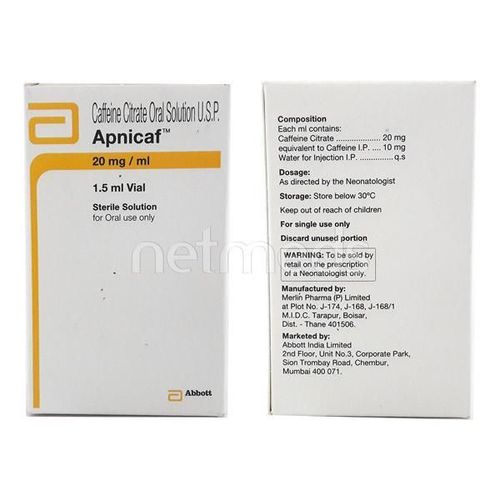
by Merlin Pharma (P) Limited· 1.5ML
SKU: 410424
You save ₹35 on this order
Inclusive of all taxes
APNICAF 20MG ORAL SOLUTION contains Caffeine which belongs to the group of
medicines called CNS stimulants. It is used to manage primary apnea (episodes of
interrupted breathing) in premature babies. Primary apnea in premature babies
happens due to immature development of baby’s breathing centers.
APNICAF 20MG ORAL SOLUTION has been shown to reduce the number of episodes of
interrupted breathing in premature newborns babies. It can also be used to
manage bronchopulmonary dysplasia (airway damage) among premature babies.
Before APNICAF 20MG ORAL SOLUTION is administered, inform your doctor if you
child has any liver, kidney or heart problems. You must also inform your doctor
if your child suffers from seizure disorders, slow weight gain or frequent
regurgitation (spitting up of milk or food) as a precaution.
If you are the mother of the premature infant who receives the management, you
must not drink coffee or take foods which has high caffeine content. This is
because the caffeine taken by the breastfeeding mother may pass through the
breast milk to the nursing premature infant who is already receiving caffeine
therapy and may lead to an overdosage. The most common side effect of APNICAF
20MG ORAL SOLUTION is fast or irregular heart rate. Consult your doctor if it
worsens.
APNICAF 20MG ORAL SOLUTION is a CNS stimulant. It works by stimulating a part of
the brain that controls breathing. As a result, the brain transfers a lot of
breathing signals to the lungs which makes the lungs breathe more deeper and
faster. It also increases the number of breathing cycles, manages the airway
damage and reduces the need for mech
APNICAF 20MG ORAL SOLUTION will be administered orally (via gastric feeding
tube) to your child only by a doctor or a nurse.
Your doctor will decide the correct dose and duration of therapy for your child
based on their gestational age, body weight and health condition.
Contact your doctor immediately if you notice any of the following side effects
in your child after APNICAF 20MG ORAL SOLUTION is administered:
!### Breastfeeding
ContraindicatedIf you are the mother of the premature infant who receives the management, you
must not drink coffee or take foods which has high caffeine content. This is
because the caffeine taken by the breastfeeding mother may pass through the
breast milk to the nursing premature infant who is already receiving caffeine
therapy and may lead to an overdosage.
!### Kidney
Use with CautionAPNICAF 20MG ORAL SOLUTION should be used with caution in babies with kidney
problems. Therefore, inform your doctor as a precaution.
!### Liver
Use with CautionAPNICAF 20MG ORAL SOLUTION should be used with caution in babies with liver
problems. Therefore, inform your doctor as a precaution.
!### Allergy
ContraindicatedIf your child is allergic to caffeine, kindly inform your doctor before APNICAF
20MG ORAL SOLUTION is administered to the child.
!### Heart Disease
Use with CautionAPNICAF 20MG ORAL SOLUTION should be used with caution in babies with heart
problems (such as irregular heart rate). Therefore, inform your doctor as a
precaution.
!### Use In Pediatrics
SafeAPNICAF 20MG ORAL SOLUTION can be used in premature infants born between 28-33
gestation weeks (7-8 months of pregnancy) under careful medical supervision.
Before APNICAF 20MG ORAL SOLUTION is administered to the baby, kindly inform the
doctor if your baby suffers from any of the following conditions:
A. Drug-Drug interactions:
Before APNICAF 20MG ORAL SOLUTION is administered to the child, kindly inform
the doctor if your child is given any of the following medicines as a
precaution:
Overdosage:
APNICAF 20MG ORAL SOLUTION will be administered only by a doctor or a nurse in a
hospital, and so it is unlikely to receive an overdose. However, consult your
doctor if you notice fits or any other side effects in your child.
| Drug | : | Caffeine |
| Pharmacological Category | : | Methylxanthines |
| Therapeutic Indication | : | Apnea of prematurity in infants |
| Dosage Forms | : | Tablet, Injection, Oral solution, Suspension |
Q: What is the use of APNICAF 20MG ORAL SOLUTION?A: APNICAF 20MG ORAL SOLUTION is used to manage primary apnea (episodes of
interrupted breathing) in premature babies. It can also be used to manage
bronchopulmonary dysplasia (airway damage) among premature babies.
Q: How APNICAF 20MG ORAL SOLUTION helps in breathing problems?A: APNICAF 20MG ORAL SOLUTION is a CNS stimulant. It works by stimulating a
part of the brain that controls breathing. As a result, the brain transfers a
lot of breathing signals to the lungs which makes the lungs breathe more deeper
and faster. It also increases the number of breathing cycles, manages the airway
damage and reduces the need for mech
Q: Is APNICAF 20MG ORAL SOLUTION safe for use in children?A: APNICAF 20MG ORAL SOLUTION can be used in premature infants born between
28-33 gestation weeks (7-8 months of pregnancy) under careful medical
supervision.
Q: Why newborn babies suffer from apnea?A: Primary apnea in premature babies happens due to immature development of
baby’s breathing centers.
Q: What are the side effects of APNICAF 20MG ORAL SOLUTION?A: The most common side effect of APNICAF 20MG ORAL SOLUTION is fast or
irregular heart rate. Consult your doctor if it worsens.
Q: Is APNICAF 20MG ORAL SOLUTION effective?A: APNICAF 20MG ORAL SOLUTION effectively improves breathing among infants
suffering from apnea of prematurity. It works by stimulating a part of the brain
that controls breathing. It also increases the number of breathing cycles,
manages the airway damage and reduces the need for mech


